Deutsch
Doughnut Economics: A Framework for Just and Regenerative Economic Thinking
An article by GenR member Fenia Gropp
What would an economic system look like that neither overburdens people nor nature, but instead achieves balance between them?
This question has fascinated me since last semester in my International Cultural and Business Studies programme, where I explored different approaches to ethical economics in depth. To pursue this interest in practice and gain insights into an organisation that combines social and ecological issues, I became a member of Generation Restoration. What particularly interests me is how just and regenerative approaches can function within our current economic system, which continues to pursue the goal of unlimited growth.
These reflections repeatedly brought up the same questions: How can resources be distributed more fairly? How can we create circular systems that generate sustainable social benefits without putting pressure on the environment? And how can the damage already caused by climate change not only be limited but also reversed in the long term?
These questions become even more significant when considering how unevenly the causes and consequences of climate change are distributed around the world. Wealthier countries contribute disproportionately to global environmental degradation and the transgression of planetary boundaries, yet they experience fewer of the associated social consequences. Poorer regions, on the other hand, benefit the least from the underlying economic activities while suffering the most from their impacts, such as rising sea levels and extreme weather events. Responsibility for causing climate change and vulnerability to its consequences are therefore structurally disconnected and unequally distributed.
Doughnut Economics Model
It is precisely this situation that economist Kate Raworth addressed when she introduced the Doughnut Economics model as a conceptual framework in 2017. The image of the “doughnut” represents two boundaries. At its centre are twelve dimensions of basic human needs, forming the social foundation. The outer ring represents the planetary boundaries, the crossing of which indicates that ecological systems are becoming unbalanced. Between these two rings lies a space that is both socially just and ecologically safe – a space from which human civilization is currently far away from reaching. Today, at least seven of the nine planetary boundaries have already been exceeded worldwide, accompanied by severe social shortfalls.

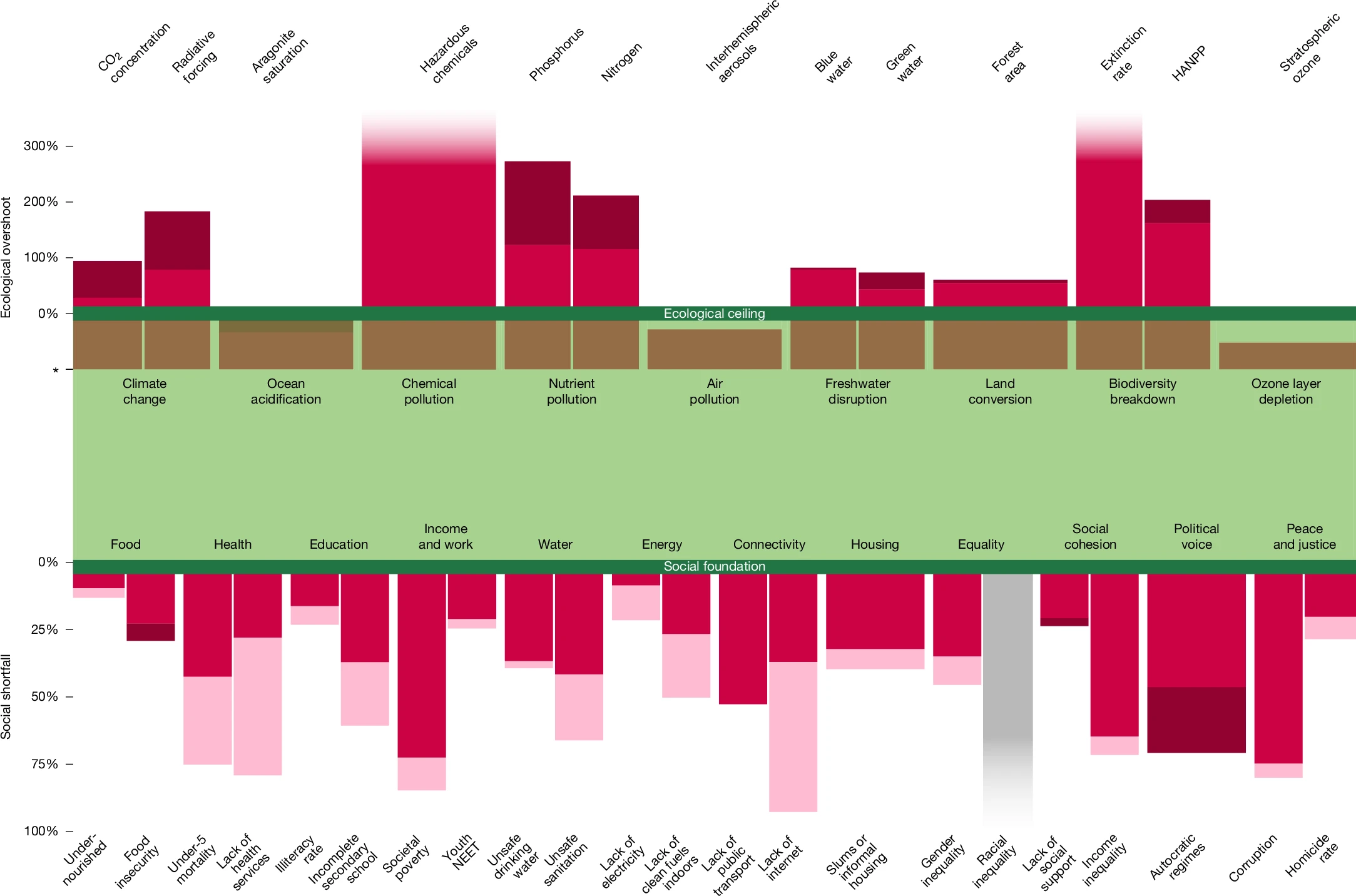
The individual dimensions are derived from the UN Sustainable Development Goals and generally consist of two different indicators. The “Food” dimension, for example, includes both the proportion of undernourished people (“undernourished”) and the extent of food insecurity (“food insecurity”). This makes it possible to see how both social shortfalls and ecological overshoot are developing across the different dimensions.
The graphic below presents the doughnut as an unrolled bar chart. In addition to the individual indicators, it illustrates how each dimension changed between 2000–2001 and 2021–2022. Light red bars indicate areas where social shortfalls or ecological overshoot have decreased, dark red bars represent worsening conditions, and grey bars indicate missing data. The chart shows, for example, that some social dimensions – such as child mortality and access to health services within the “Health” dimension – have improved, while other dimensions, particularly planetary ones such as climate change, including rising CO₂ concentrations, have continued to deteriorate. The doughnut therefore does not represent a static condition but instead illustrates how individual dimensions change over time.
Looking Ahead
For me, the combination of social justice and planetary boundaries makes Doughnut Economics a particularly interesting perspective on many of the questions I encounter through Generation Restoration. It offers an approach to understanding interconnected crises as fundamentally linked.
As part of my bachelor’s thesis, I will therefore explore the principles of Doughnut Economics in greater depth and investigate possible connections with Generation Restoration. I look forward to hearing your thoughts and ideas on this topic, and I will be happy to share the insights that emerge throughout my research as it progresses.
Sources
Fanning, A.L., Raworth, K. Doughnut of social and planetary boundaries monitors a world out of balance. Nature 646, 47–56 (2025). https://doi.org/10.1038/s41586-025-09385-1
Meißner, A., Bort, S., & Sahan, E. (2026). Doughnut Economics for Regenerative Business Design: Case Studies and Critical Reflections (p. 242). transcript Verlag.
Pogge, T. (2022). Weltarmut und Menschenrechte – Essay | Entwicklungszusammenarbeit | bpb.de. bpb.de. https://www.bpb.de/shop/zeitschriften/apuz/200376/weltarmut-und-menschenrechte-essay/
Raworth, K. (2017). A Doughnut for the Anthropocene: humanity’s compass in the 21st century. Lancet Planet. Health 1, e48–e49
Raworth, K. (2018). Doughnut economics: Seven ways to think like a 21st century economist. Chelsea Green Publishing.
Raworth, K (2025). The Evolving Doughnut, Doughnut Economics Action Lab, Oxford. https://doi.org/10.64981/XGRX2738.